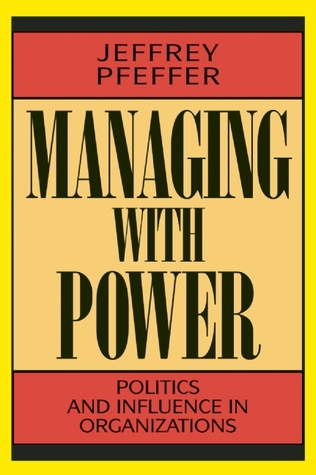
Politics and Influence in Organisations by Jeffrey Pfeffer
ISBN: 0-87584-440-5
First published 1992
345 pages
Cover design: Not credited
4/5 Stars
How to be successful in organisations? Jeffrey Pfeffer shows us how politics and influence are vital in achieving our goals within organisations. He considers the building of coalitions towards action, and that action can only take place by the judicious use of power. He shows us the skills needed for the acquisition, the keeping of, and the use of power. He also shows us what happens when those in power fall, how changes in the environment, or the tendency to become over-confident can lead to a sudden loss of power, and ultimately the demise and exit from an organisation.
How many of us are aware of the Golden Rule? (Whoever has the gold, rules)
How many of us are aware of the law of the Unobvious Choice? (Promote those who not obvious candidates and they will be loyal for the rest of their working lives).
Included are wonderful examples, of Xerox and Palo Alto, of law firms and Californian energy companies, even the United States Senate. We are familiar with Steve Jobs and the rise of Apple and the iPhone, but how many of use remember the battles during Steve Jobs first tenure of Apple? The disaster of the LISA, the struggles with the MACINTOSH, the takeover by John Sculley, the power of the Apple HR department and the in-fighting between departments. Or, how Lyndon Johnson used his power to pass civil rights legislation, having previously been against it, and previously never having passed anything through Congress. How many of us knew the power exhibited by Henry Ford II when he took over the Ford Motor Company after WW2?
Jeffrey Pfeffer issues call to action in the last chapter. Organisational failure is often the result of personnel and employees refusing to use the tools of politics and influence to “get things done”.
This is a recipe for organisational demise.
To quote him on page 344, “Analysis and forethought are…fine. What is not so fine is paralysis or inaction…”. If we can understand and use the tools for success, power and influence, then us as individuals and organisations can prosper.
 The Eclectic Book Review